
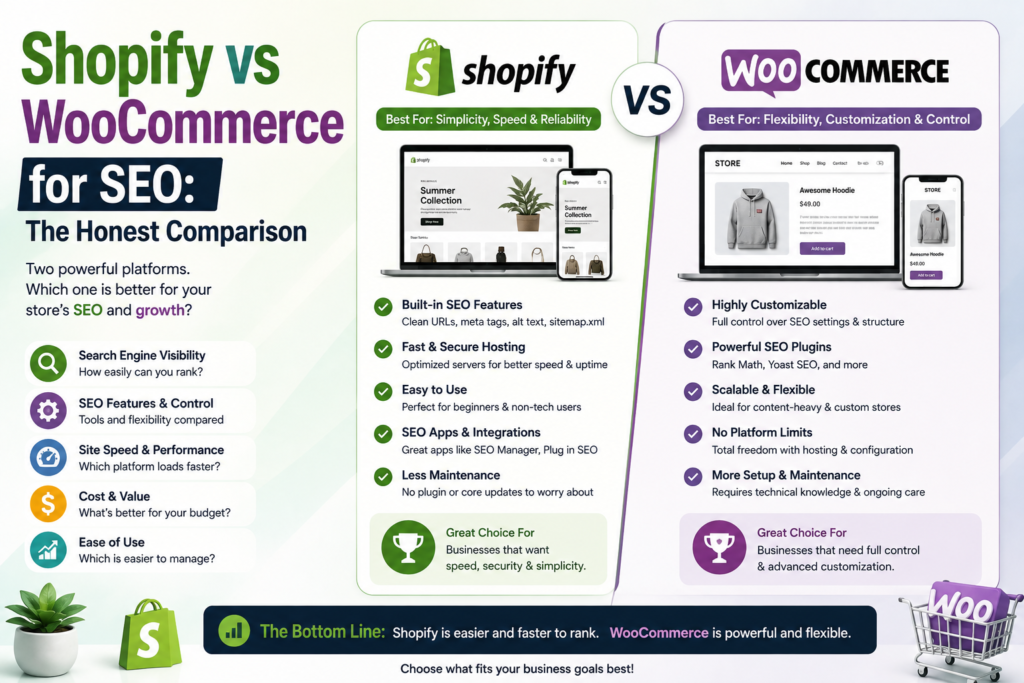
Every comparison article online is written by someone with an affiliate link. Here is the version from actually running SEO on both.
Is Comparison Mein
Short answer: neither platform outranks the other. Ranking is decided by content, links and technical discipline — all of which are your job on either. What differs is which mistakes each platform makes easy, and how much control you get when you need it. (Part of our complete Shopify SEO guide.)
URL Structure
Shopify: locked. Every product lives under /products/, every collection under /collections/, blog posts under /blogs/. You cannot remove these prefixes. You also get the duplicate-path problem — the same product reachable at /products/x and /collections/y/products/x.
WooCommerce: fully editable. You can serve products at /blue-kurta/ if you want, and structure categories however you like.
Verdict: WooCommerce wins on paper. In practice, URL prefixes are a minor ranking factor and Shopify’s canonicals handle the duplication when the theme does not break them. Not a reason to choose a platform.
Speed
Shopify: fast, well-provisioned hosting with a global CDN included. You cannot make the server slow. You can absolutely make the store slow by installing fifteen apps.
WooCommerce: entirely dependent on your hosting. Cheap shared hosting will be slower than Shopify. Good managed WordPress hosting can be faster. Either way you own caching, CDN and updates.
Verdict: Shopify wins for most store owners because the floor is high and nothing is your responsibility. WooCommerce wins only if you have real technical support behind it.
Technical Control
Shopify: you get Liquid templates, robots.txt.liquid and theme code. You do not get server config, .htaccess, or control over checkout on lower plans.
WooCommerce: you control everything — server, plugins, database, redirects, headers.
Verdict: WooCommerce, decisively. This matters when you have an unusual technical problem. It matters very little for a standard catalogue store.
Structured Data
Shopify: most good themes ship product schema. Apps sometimes add a second conflicting block. Fixable, but you are editing Liquid.
WooCommerce: WooCommerce outputs product schema natively, and plugins like Rank Math or Yoast extend it further with a UI.
Verdict: WooCommerce is easier to get right without touching code.
Content and Blogging
Shopify: the blog is basic. Limited categories, no proper tag architecture, weak editorial tooling. Building a real content cluster on Shopify’s blog is possible but fights the platform.
WooCommerce: it is WordPress. Content is the thing WordPress does best — categories, tags, custom post types, the full editorial toolkit.
Verdict: WooCommerce, clearly. If your SEO strategy is content-led, this is the single most meaningful difference in this article.
Maintenance and Risk
Shopify: updates happen without you. Security is Shopify’s problem. Apps break occasionally; the store rarely goes down.
WooCommerce: you own updates, backups, security and plugin conflicts. A bad plugin update can take a site offline, and an unmaintained WordPress install will eventually get compromised.
Verdict: Shopify, by a wide margin, for anyone without technical staff.
Cost
Shopify: predictable subscription plus app fees plus transaction fees on some payment setups. App costs creep.
WooCommerce: software is free; hosting, premium plugins, developer time and security are not. Often cheaper at small scale, comparable or more at large scale once you count maintenance.
Verdict: genuinely depends on your scale and whether you have in-house technical help.
So Which Should You Choose?
Choose Shopify if you want to sell rather than administer software, you do not have a developer on hand, and your growth plan is products and ads rather than a large content operation.
Choose WooCommerce if content marketing is central to your strategy, you need unusual technical control, or you already run WordPress and have someone maintaining it.
Do not switch platforms hoping for a ranking boost. Migration is a risk, not a growth tactic. Stores lose traffic in migrations far more often than they gain it. Switch when the platform genuinely blocks your business — and when you do, plan the SEO side properly. We cover exactly that in migrating without losing rankings, and handle it as a service at Shopify migration.
What Actually Decides Rankings
On either platform, the same things win:
- Unique, useful content on collection and product pages
- Clean indexation with no duplicate URLs competing
- Green Core Web Vitals on mobile
- Genuine links from real sites
- Consistent publishing over months, not weeks
Every store we have taken to page one did those. None of them did it because of the platform.
Not sure which side of this you are on? WhatsApp your store link to +91 92113 84333 — we will tell you straight whether the platform is your problem, and it usually is not.
Next in this series: Migrating to Shopify Without Losing Rankings. Back to the pillar guide.
Not Sure Which Side You Are On?
WhatsApp your store link to +91 92113 84333 — we will tell you straight whether your platform is actually the problem. Usually it is not.