
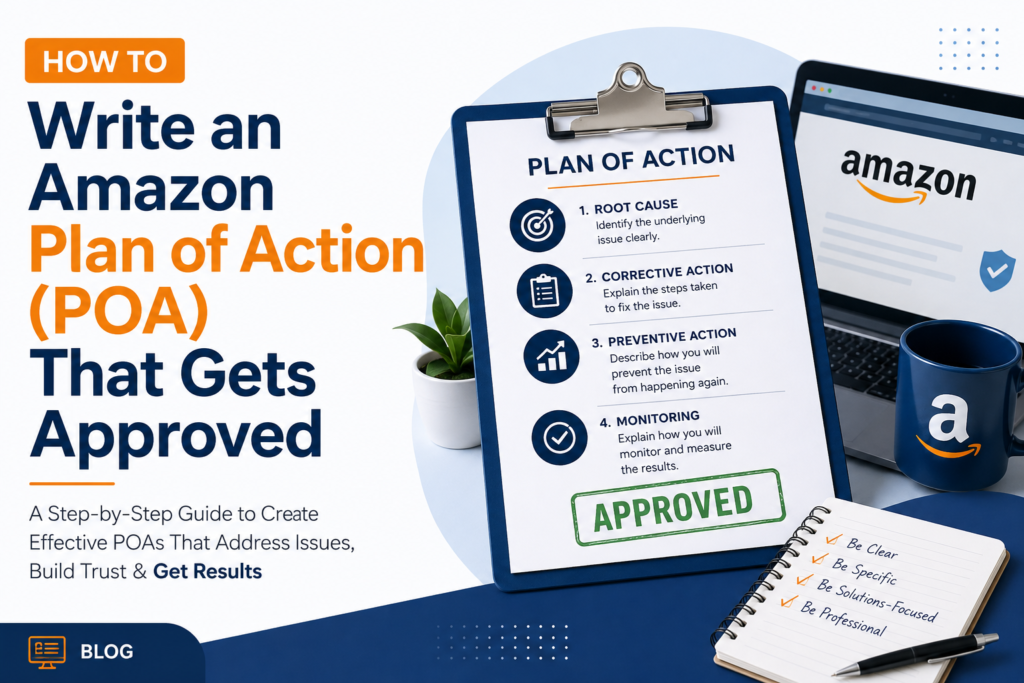
When Amazon deactivates your account, it usually invites you to submit a Plan of Action. Most sellers treat this as an apology letter. It isn’t. A POA is a short business document that answers three questions, and the sellers who understand that get reinstated while the ones who write emotional pleas keep getting rejected. (Part of our complete suspension recovery guide.)
Is Guide Mein
Before you write a single word
Diagnose the real trigger. Amazon’s notification names a policy, not a cause. Your POA must address what actually happened in your account — the late shipments in March, the specific ASIN that drew an authenticity complaint — not the generic policy text. A POA that answers the wrong accusation is rejected no matter how well written.
Understand what you’re spending. Every appeal attempt is counted. Your first POA has the best odds; each rejection narrows the path and hardens the reviewer’s view. This is why firing off a quick appeal within an hour of the email is the single most expensive mistake in the process. Take a day, get it right.
The three-part structure
Amazon’s reviewers read hundreds of these. They skim for structure. Give them exactly three sections, clearly labelled.
1. Root cause — what went wrong, specifically
State the actual failure in your operation, with numbers and dates. Own it completely.
✅ “Our Order Defect Rate reached 1.8% in March 2026. Reviewing our defect report, 11 of the 14 defects came from orders shipped through a single courier partner whose delivery-failure rate we were not monitoring. We had no process to review carrier performance weekly.”
The second version tells the reviewer you actually investigated. The first tells them nothing.
2. Corrective actions — what you have already done
Past tense only. Anything you’re “planning to do” belongs in section three. Attach or reference evidence.
Typical corrective actions:
- Refunded or replaced every affected order (list order IDs)
- Removed or corrected the specific listings involved
- Obtained proper supplier invoices for the ASINs in question
- Terminated the courier / supplier relationship that caused the failures
- Cleared the outstanding balance or completed the verification Amazon requested
3. Preventive measures — the systems that make recurrence impossible
This is the section reviewers weigh most, and the one sellers write worst. Vague promises fail. Describe mechanisms.
✅ “Every Monday, our operations lead reviews Account Health (ODR, Late Dispatch, Cancellation Rate) and logs it in a shared sheet. Any metric within 20% of Amazon’s threshold triggers immediate action. We have moved our five highest-volume SKUs to FBA to remove carrier risk, and we now hold 15% buffer stock on all multi-channel SKUs to prevent stockout cancellations.”
What separates approved POAs from rejected ones
- Specificity. Template language is invisible to reviewers who see it a hundred times a day. Numbers, dates, invoice references and named process changes stand out.
- Accepting responsibility. POAs that blame buyers, couriers, or Amazon itself fail — even when the complaint was genuinely unfair. The winning frame is: “here is how we ensure even unfair complaints can’t damage our metrics.”
- Evidence attached. Supplier invoices matching your registered business name, proof of refunds, screenshots of the new process. Claims without documents are just words.
- Brevity and structure. One page. Three labelled sections. Bullet points. Reviewers skim — structure is a courtesy that gets you read.
- No emotion. Job losses, family circumstances, how long you’ve sold on Amazon — none of it moves a policy decision, and it dilutes the parts that do.
A skeleton you can adapt
ROOT CAUSE
[What specifically happened, with dates and numbers. What process was
missing that allowed it.]
CORRECTIVE ACTIONS TAKEN
– [Action already completed, with evidence reference]
– [Action already completed, with evidence reference]
– [Action already completed, with evidence reference]
PREVENTIVE MEASURES IMPLEMENTED
– [Specific ongoing process, who does it, how often]
– [System / tooling / staffing change]
– [Threshold that triggers escalation internally]
We understand our responsibility to provide a consistent customer
experience and have made the operational changes above to ensure this
does not recur. Supporting documents are attached.
[Business name, Merchant ID]
After you submit
Amazon may come back with follow-up questions — that is normal and a good sign, not a rejection. Answer each one within 24–48 hours, addressing exactly what was asked and nothing more. If the appeal stalls after two rounds, there are further escalation paths, each with its own etiquette.
Realistic timelines: metric-based suspensions with a clean first POA often resolve in 1–3 weeks. Authenticity and IP cases run 2–6 weeks. Related-account and review-manipulation cases take longest and are least certain.
When to get help
You can absolutely write your own POA — many sellers do successfully. Professional help genuinely changes three things: the diagnosis (many self-written appeals answer the wrong accusation), the quality of the first attempt (your best odds), and knowing the escalation paths when standard appeals stall.
No honest agency can guarantee reinstatement, and you should be wary of anyone who does. What we do guarantee is a properly diagnosed, evidence-backed appeal — and if we believe a case genuinely can’t be recovered, we tell you that before taking your money.
Suspended? Free Case Assessment
Send your suspension notification on WhatsApp to +91 92113 84333 for a free case assessment, or read more about our reinstatement service.
Next in this cluster: Amazon IP Complaints — How to Respond and Get Reinstated. Back to the pillar guide.