
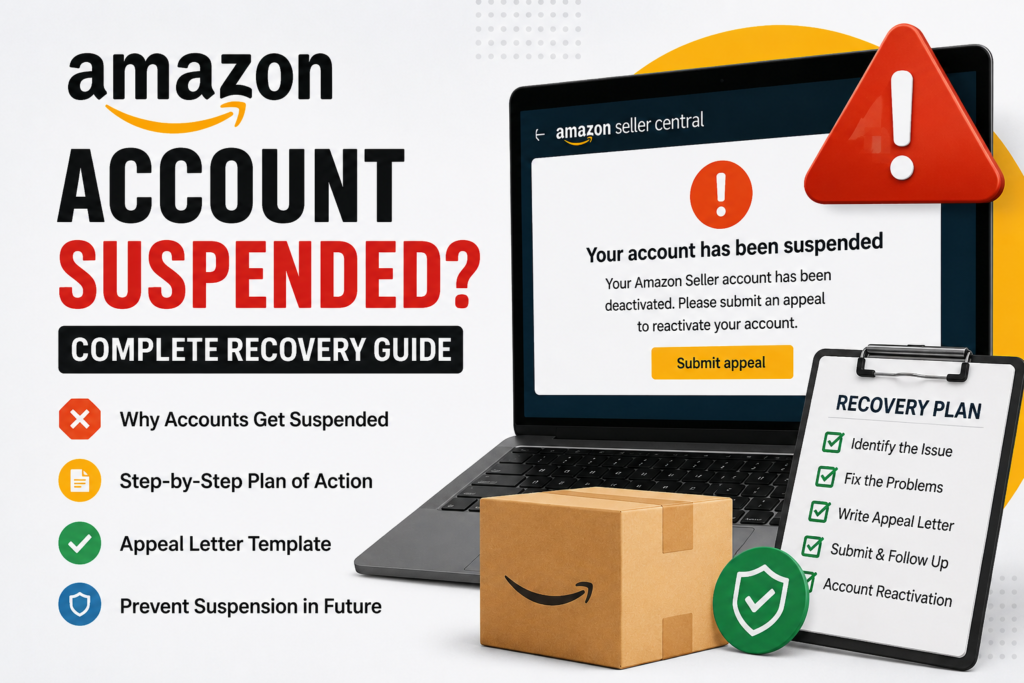
Few emails hit an Indian seller harder than “Your Amazon seller account has been deactivated.” Sales stop instantly, funds freeze, FBA inventory sits hostage in a warehouse — and Amazon’s own guidance on what to do next is famously vague. This guide covers the full journey: why accounts get suspended, how recovery actually works, what a winning appeal looks like, and how to make sure it never happens again.
Is Guide Mein
- First, Understand What Kind of Suspension You Have
- The Real Reasons Indian Seller Accounts Get Suspended
- How Recovery Actually Works: The Plan of Action (POA)
- Realistic Timelines (and What “Waiting” Should Look Like)
- The Honest Part: Can You Guarantee Reinstatement?
- After Reinstatement: Account Health as a Weekly Discipline
- Suspended Right Now? Do These Three Things
We reinstate suspended accounts professionally — Amazon, and also Meesho, Flipkart, eBay and other marketplaces — so everything below comes from cases we’ve actually worked, not theory.
First, Understand What Kind of Suspension You Have
Amazon “suspension” is one word for several different situations, and the recovery path differs for each:
- – Listing deactivation — one ASIN suppressed or blocked (policy, compliance, complaint). Account still alive. Fastest to fix.
- – Account deactivation under Section 3 — the big one: your selling privileges are removed. The notification email names (sometimes vaguely) the policy area involved.
- – Account under review / on hold — you can often still sell, but payouts pause while Amazon investigates (commonly velocity reviews for fast-growing new accounts).
- – Funds disbursement hold — account closed or restricted with money held; a separate process governs when funds release.
- – Related-account suspension — your account is linked to another suspended account (shared address, bank, device, GST). Hardest category; the appeal must resolve the other account’s story too.
Read your notification email three times before doing anything. The exact wording — which policy is cited, what evidence is requested, whether a Plan of Action is invited — decides your entire strategy. The single worst move is firing off an emotional, generic appeal within the first hour. Amazon counts appeal attempts; a wasted first appeal makes every later one harder.
The Real Reasons Indian Seller Accounts Get Suspended
In rough order of what we see:
- 1. Order Defect Rate (ODR) above 1% — negative feedback, A-to-Z claims and chargebacks combined. Usually a symptom of product quality, courier issues or slow support.
- 2. Late Dispatch Rate above 4% / Cancellation Rate above 2.5% — operational discipline metrics. Self-ship sellers during festival season are the classic victims.
- 3. Inauthentic / authenticity complaints — a buyer or brand claims your product isn’t genuine. Amazon asks for supplier invoices; sellers sourcing from informal wholesale channels without proper invoices get stuck here.
- 4. Intellectual property complaints — trademark or copyright claims, sometimes legitimate, sometimes weaponised by competitors.
- 5. Related accounts — a second account (yours, a family member’s, a former partner’s) got linked and one of them has problems.
- 6. Review manipulation — incentivised reviews, friends-and-family reviews, review-swap groups. Amazon’s detection is far better than sellers assume, and this category is the hardest to recover from.
- 7. Dropshipping policy violations — shipping directly from a third party with their invoices in the box.
- 8. Restricted products — items requiring approvals/certifications listed without them.
Notice a pattern: most of these are preventable operational issues, not bad luck. That matters, because your appeal must show you understand the root cause — and your future account health depends on actually fixing it.
How Recovery Actually Works: The Plan of Action (POA)
For most Section 3 deactivations, Amazon invites you to submit a Plan of Action. A POA is not an apology letter, not a legal threat, and not a wall of emotion. It’s a structured business document with three parts:
1. Root cause — what actually went wrong, stated specifically and honestly. “Our ODR crossed 1% because 40% of our December orders shipped via a courier partner whose delivery failures we didn’t monitor” — not “we are very sorry for the inconvenience.”
2. Immediate corrective actions — what you have already done (past tense, with evidence): refunded affected buyers, removed problem listings, changed courier, obtained proper invoices, hired support help.
3. Preventive measures — the systems that make recurrence impossible: weekly metric reviews, new QC step before dispatch, supplier verification process, inventory buffers. Specific and operational, not promises to “be more careful.”
What separates approved POAs from rejected ones, in our experience:
- – Specificity. Amazon’s reviewers read hundreds of these; template language is invisible to them. Numbers, dates, invoice references and named process changes stand out.
- – Accepting responsibility. POAs that blame buyers, couriers or Amazon itself fail. Even when a complaint was unfair, the winning frame is “here’s how we make sure even unfair complaints can’t hurt our metrics.”
- – Evidence attached. Supplier invoices matching your business name (see our documents guide), proof of refunds, screenshots of new processes.
- – Brevity with structure. One page, clearly sectioned, bullet points. Reviewers skim; structure is kindness.
Realistic Timelines (and What “Waiting” Should Look Like)
- – Simple verification/billing issues: days.
- – Metric-based suspensions with a clean first POA: 1–3 weeks, sometimes one or two rounds of follow-up questions.
- – Authenticity/IP cases: 2–6 weeks, driven mostly by how fast you can produce acceptable invoices or complaint retractions.
- – Related-account and review-manipulation cases: longest and least certain — weeks to months, and some don’t come back.
While waiting: respond to every Amazon request within 24-48 hours, keep fulfilling any still-active channels flawlessly, and do not open a new account — Amazon links accounts by identity, banking, devices and network; a new account created after suspension is usually detected, closed, and used as evidence of bad faith against your original appeal.
The Honest Part: Can You Guarantee Reinstatement?
No — and be suspicious of anyone who does. What professional help genuinely changes:
- – Correct diagnosis — many self-written appeals fail because they answer the wrong accusation. The notification’s vague wording routinely misleads sellers about the real trigger.
- – A first appeal that counts — your first POA is your best odds; each rejection narrows the path. Professionals spend their day inside these processes and know what reviewers expect for each suspension category.
- – Escalation paths — when standard appeals stall, there are further steps (seller support escalations, executive escalations) that have their own etiquette.
If a case is genuinely unwinnable — a clear-cut fraud finding, for example — an honest consultant tells you that before taking your money. That’s our policy at EcomExpert: send us your suspension notification on WhatsApp (+91 92113 84333) and our reinstatement team will assess it free. We tell you the realistic odds first; you decide after.
After Reinstatement: Account Health as a Weekly Discipline
Reinstated accounts get suspended again at a depressing rate — because the seller celebrates and goes back to old habits. The fix is a boring weekly ritual:
- 1. Every Monday, open Account Health. ODR, Late Dispatch, Cancellation Rate, Valid Tracking Rate, policy notifications. Ten minutes. (Benchmark yours against Amazon’s thresholds with our free Account Health Checker.)
- 2. Treat every policy warning as a fire alarm — a warning answered well today is a suspension avoided next quarter.
- 3. Fix causes, not symptoms — if ODR creeps, the answer lives in your courier data, QC process or listing accuracy, not in hoping next week is better.
- 4. Keep your paper trail permanently ready — supplier invoices, brand authorizations, GST records filed so any authenticity question can be answered same-day.
- 5. Mind the calendar — metrics break during festival volume spikes. If August operations strained you, fix capacity before October (our festive checklist covers this).
Most sellers don’t need help with this list — they need someone who actually does it every week. That’s a big part of what our account management service is: professional paranoia, applied weekly, so the suspension email never comes.
Suspended Right Now? Do These Three Things
- 1. Save everything — the notification email, your metrics screenshots, recent complaints. Evidence ages badly.
- 2. Diagnose before appealing — which suspension category are you actually in? The email’s cited policy + your recent account history together tell the story.
- 3. Make your first appeal count — one specific, evidence-backed, well-structured POA beats five fast generic ones. Every time.
Or skip the trial-and-error: WhatsApp your suspension notification to +91 92113 84333 and get a free case assessment — what triggered it, what recovery looks like, and whether it’s worth pursuing. We recover accounts on Amazon, Meesho, Flipkart, eBay, Alibaba and GlowRoad — it’s one of the things we do most, and the reviews in our clients’ words say it best.
Deep-dives in this cluster (publishing soon): Top 10 Suspension Reasons in India · How to Write a POA That Gets Approved · Responding to IP Complaints · ODR Explained · Late Shipment & Valid Tracking Rate Guide.