
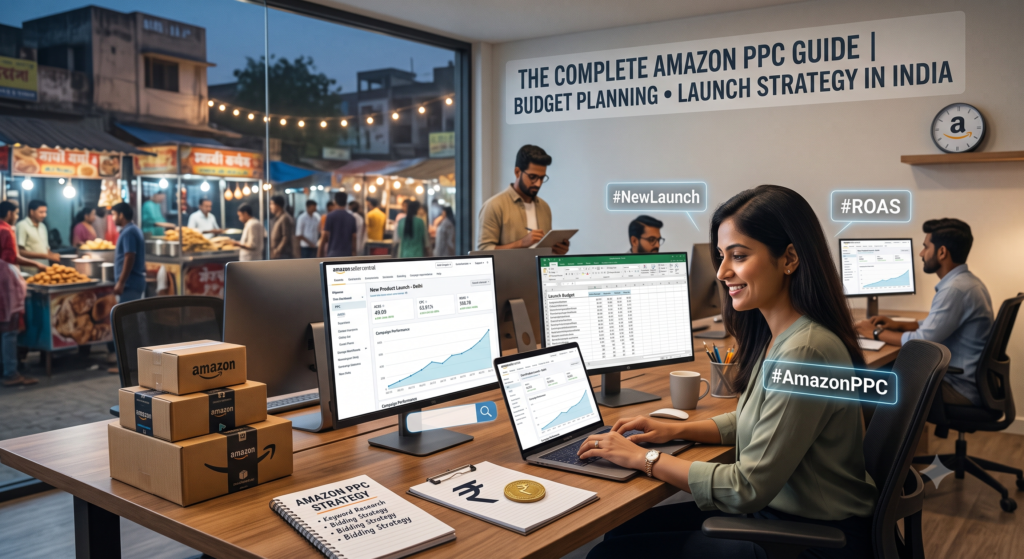
New sellers get this wrong in two opposite directions. Some spend almost nothing, wait for organic sales that never arrive because a brand-new listing has no ranking to be organic with. Others throw an aggressive daily budget at day one auto campaigns and burn through weeks of cash before they have enough data to know what’s converting. Both mistakes come from not having a plan before the campaigns go live.
Is Guide Mein
Why Launch Budgeting Is Different
A mature product’s PPC budget is set by known conversion data — you know roughly what a click costs and what it’s worth. A new launch has none of that yet. Every rupee in the first two to four weeks is buying information as much as it’s buying sales: which keywords convert, what your real CVR is, where your break-even bid sits. Budget the first month as a research cost, not a profit line, and the rest of the plan gets much easier.
How Much to Budget: A Starting Rule of Thumb
There’s no single right number — category CPCs vary too much — but this is the framework we use to set an opening budget rather than guessing:
- Estimate your break-even ACoS from your margin (see our ACoS guide if you haven’t calculated this yet).
- Accept a launch-period ACoS 1.5-2x your break-even for the first 30 days. This isn’t reckless spending — it’s the accepted cost of the reviews and sales velocity a new listing needs before organic ranking kicks in.
- Set a daily budget that gets you 15-30 clicks a day minimum across your campaigns. Below that, you won’t accumulate enough data to make harvest and negative-keyword decisions within a reasonable time. Above roughly 60-80 clicks a day for one ASIN, you’re usually accelerating spend faster than you can act on the data it produces.
Run the numbers through our ROI calculator before committing — it’s worth knowing your true break-even before you set day-one bids, not after week three.
A Week-by-Week 60-Day Plan
| Weeks | Focus | What to Do |
|---|---|---|
| 1-2 | Discovery | Auto campaign live at moderate budget, broad/phrase manual campaigns on your top 10-15 keyword guesses. No exact match yet — you don’t have proven winners. |
| 3-4 | First harvest | Pull search term reports twice. Move any converting terms into a dedicated exact-match campaign. Start negating clear zero-order terms in auto. |
| 5-6 | Tightening | Exact match campaign should be carrying a growing share of sales. Cut bids on manual terms with poor ACoS instead of pausing them outright. |
| 7-8 | Stabilising | Compare current ACoS to your break-even target. If you’re within range, hold budget and shift focus to conversion-rate levers on the listing itself. If still well above break-even, review whether the listing — not the ads — is the real bottleneck. |
This isn’t a rigid schedule — a listing with strong early reviews might tighten faster; a competitive category might need the discovery phase extended. Treat the weeks as a sequence of decisions, not a calendar.
Signals to Push Spend Forward
- Conversion rate is holding or improving as volume increases — the listing can handle more traffic profitably.
- A growing share of sales is coming from exact-match keywords you’ve already harvested and can bid on with confidence.
- Organic rank is visibly climbing for your main keywords when you check manually — a sign the ad spend is doing its real job of building velocity, not just buying isolated sales.
- Stock can support it. Never scale ad spend faster than your inventory runway — running out of stock mid-launch resets the ranking momentum you just paid to build.
Signals to Pull Spend Back
- ACoS is climbing over multiple weeks with no sign of stabilising, even after negative-keyword cleanup and bid adjustments.
- Conversion rate is well below category norms — this usually means the listing (images, price, reviews, title) needs work before more traffic will help. More spend on a weak listing just buys more evidence that it’s weak.
- You’re seeing clicks concentrate on a handful of expensive, competitive keywords with thin margin — sometimes the honest answer for month one is to narrow focus rather than widen it.
- Cash flow can’t sustain the pace. A launch budget that outruns your working capital forces a pause at the worst possible moment — mid-momentum — which costs more in lost ranking than a slower, sustainable pace would have.
What Sellers Get Wrong Most Often
- Setting the budget once and never revisiting it. Launch budgets should move weekly based on what the data shows, not sit fixed for two months.
- Judging week one on ACoS. There isn’t enough data yet for the number to mean anything — judge week one on click volume and early search-term signal instead.
- Cutting spend the moment ACoS looks high, without checking whether it’s a listing problem or an ads problem first.
- Ignoring stock levels when planning ad spend. A budget that outpaces your inventory is a budget that will strand you mid-launch.
The Honest Summary
Budget the first month to learn, not to profit. Use that data to build a protected exact-match campaign by week four, and judge the next month against your real break-even ACoS rather than a number you guessed on day one. Sellers who plan this way spend less overall than sellers who either hold back and stall, or spend blind and burn cash before they have the keyword data to spend well.
Planning a launch and not sure what to budget? WhatsApp your product and category to +91 92113 84333 — we’ll give you a realistic starting number and a week-by-week plan before you spend a rupee. Our Amazon PPC management runs new-launch campaigns exactly this way.
Related: Auto vs Manual Campaigns: The Hybrid Strategy · How to Lower Amazon ACoS Without Losing Sales Volume
Planning a Launch?
WhatsApp your product and category to +91 92113 84333 — we will give you a realistic starting budget and a week-by-week plan before you spend a rupee.