
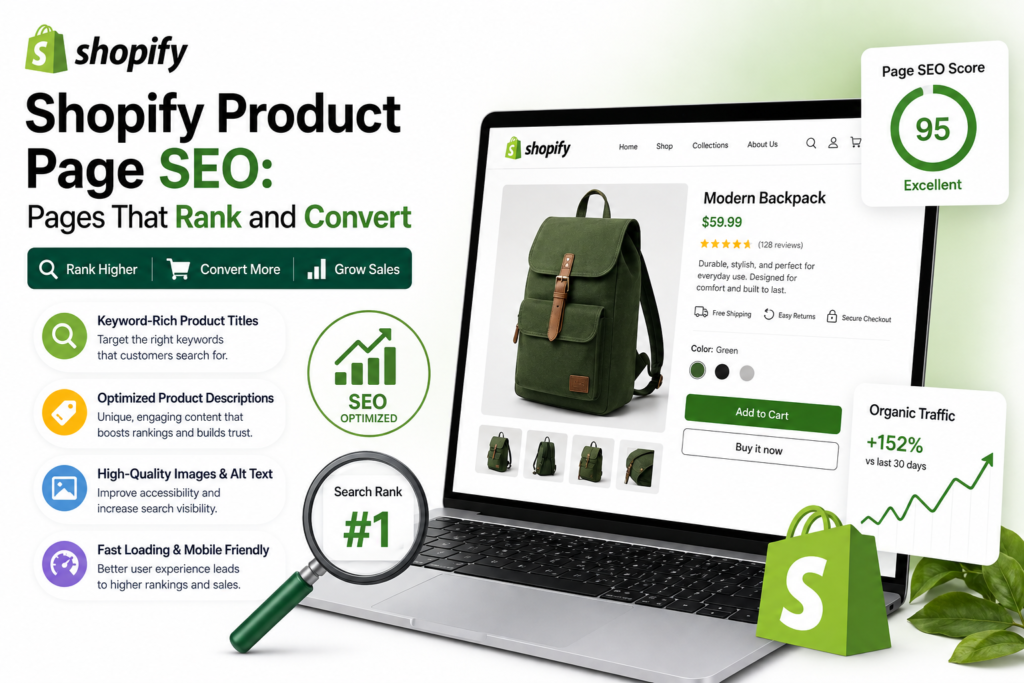
Product pages are where the money is, and where most Shopify stores do the least work. A supplier-pasted description, a title copied from the invoice, four images with no alt text — and then the owner wonders why the store gets no organic traffic.
Is Guide Mein
This is how to fix that, page by page. (Part of our complete Shopify SEO guide.)
Start With the Duplicate URL Problem
Before you write anything, check this. Shopify serves the same product at two addresses:
yourstore.com/products/blue-cotton-kurtayourstore.com/collections/kurtas/products/blue-cotton-kurta
Both are crawlable. Shopify sets a canonical tag pointing to the clean /products/ version — but themes and apps break it regularly. Open a product page from inside a collection, view source, and confirm the canonical points at /products/. If it points at itself, every product in your store is competing with several copies of itself.
Fixing this one thing has moved more Shopify stores than any amount of copywriting.
Product Titles
Your title tag is the biggest on-page signal you control. Write it in buyer language.
Weak: KRT-4471-BLU | MyStore
Better: Blue Cotton Kurta for Women — Full Sleeve, Machine Washable | MyStore
Rules that hold up:
- Lead with the primary product term people actually search
- Include the attributes that appear in real queries: colour, material, size range, use case
- Keep it under about 60 characters visible, brand at the end
- Never repeat the brand name three times
Shopify’s default title template appends your store name to everything. Override it per product for your top sellers at minimum.
Descriptions That Do Two Jobs
The description has to satisfy a buyer’s doubts and give Google something unique to index. Supplier text does neither — it exists identically on a hundred stores.
Structure that works:
- One-line hook — what it is and who it is for
- Bullet specs — material, dimensions, fit, what is in the box
- Use case paragraph — when and how people actually use it
- Care and sizing — the questions that drive returns and support tickets
- Delivery and returns — reduce the last-mile hesitation
Aim for 150–300 words of genuinely useful text on priority products. You do not need this on every SKU on day one; do your top 50 by revenue first.
If you sell on marketplaces too, the same discipline applies there — see our Amazon listing services.
Images
- Alt text on every image, describing what is in the picture. “Blue cotton kurta, front view, full sleeve” — not a keyword list.
- Descriptive filenames before upload.
blue-cotton-kurta-front.jpg, notIMG_4471.jpg. - Right-sized files. Uploading a 3000px original and letting the browser scale it down is the most common Shopify speed killer.
- Multiple angles plus a scale reference. This is conversion, not SEO, but dwell time and return rate both feed back into performance.
Structured Data
Product schema is what turns a plain blue link into a result showing price, availability and star rating. Same position, noticeably more clicks.
Most decent Shopify themes output product schema already. Verify it — paste a product URL into Google’s Rich Results Test. Common failures we see:
- Price present but
availabilitymissing - Review markup on a product with no reviews (a manual-action risk, not a shortcut)
- Two conflicting schema blocks because an app added its own
Fix the errors rather than adding another app on top.
Reviews
Real reviews add unique text to the page, answer objections, and enable rating stars in search results. Ask for them by email after delivery. Do not fabricate them — fake review markup is one of the few SEO shortcuts Google actively penalises.
Variants
Colour and size variants usually should not be separate indexable URLs — they fragment your signals. Keep one canonical product page with variants selectable on it. The exception is when a variant genuinely has its own search demand and its own buyers; then it deserves its own page with its own content.
Internal Links Into Product Pages
A product page four clicks from the homepage with nothing pointing at it will not rank. Link to your best sellers from:
- Relevant collection copy
- Blog posts that discuss the category
- “Complete the look” or related-product blocks
- The homepage, for your top handful
A Realistic Order of Work
- Fix canonicals and confirm no duplicate indexation
- Rewrite titles for your top 50 products by revenue
- Rewrite those descriptions
- Add alt text and compress images
- Validate product schema
- Turn on review collection
- Build internal links to the winners
That sequence is deliberately front-loaded on things that affect every page at once.
Want the audit done for you? Our Shopify SEO service starts free — WhatsApp your store link to +91 92113 84333 and we will send the three biggest issues we find.
Next in this series: Core Web Vitals for Shopify. Back to the pillar guide.
Free Product Page Review
WhatsApp us a link to any product page at +91 92113 84333 — we will tell you exactly what is costing you rankings and clicks on it, free.