
Most of what’s written about Meta Ads targets D2C e-commerce brands running conversion campaigns to a Shopify store. A local business — a clinic, a salon, a coaching centre, a restaurant, a service provider with a defined service area — needs a different playbook. Here’s the beginner’s version built for that kind of business specifically.
Is Guide Mein
Pick the Right Objective First
Meta’s ad platform asks you to choose a campaign objective before anything else, and picking the wrong one wastes budget from the first day.
- Leads — for businesses that want a form filled, a call requested, or a WhatsApp message started. This is usually the right default for local service businesses (clinics, coaching, home services, consultants).
- Traffic — sends people to your website or a specific page. Useful if your site itself is built to convert well, less useful if it just sends curious clicks nowhere in particular.
- Engagement — grows likes, comments, and shares. Cheap, but rarely worth running alone for a business that needs actual customers rather than vanity numbers.
- Sales / Conversions — for businesses with e-commerce tracking set up (a Meta Pixel or Conversions API reporting actual purchases). Not the right choice for a service business without online checkout.
For most local businesses, Leads is the objective to start with — it’s built for exactly the “message us” or “book a call” flow that local service businesses run on.
Targeting: Radius Before Interests
The single biggest mistake local businesses make with Meta Ads is targeting broadly by interest and forgetting geography. A gym in Sector 62 Noida targeting “fitness enthusiasts” across all of India is paying to reach people who can never walk through the door.
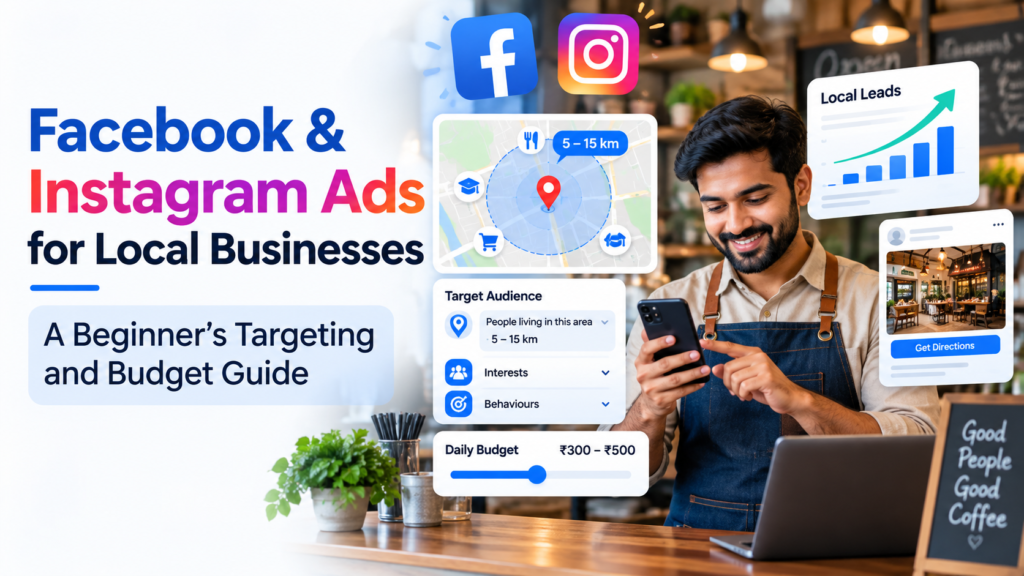
Set your radius first, interests second. Most local businesses do well with a 5-15km radius around their location, adjusted for how far customers realistically travel for what you offer — a premium clinic might justify a wider radius than a neighbourhood salon.
Within that radius, layer in relevant interest or behaviour targeting, but keep the audience big enough that Meta’s algorithm has room to optimise — an audience under roughly 50,000-100,000 people in India is often too narrow for the platform to learn efficiently from.
Budget: What’s Realistic to Start
- Testing phase (first 1-2 weeks): ₹300-₹500/day is enough to start gathering data on which creative and audience combination performs, without committing serious budget before you know anything works.
- Once a combination is clearly working: scale gradually — increasing budget by 20-30% every few days rather than jumping 5x overnight, which resets Meta’s learning phase and temporarily tanks performance.
- Realistic monthly range for a single-location local business: ₹10,000-₹40,000/month covers meaningful testing and ongoing campaigns for most service categories; multi-location or higher-ticket businesses often need more to cover a wider radius and more competitive audiences.
Creative Is Where Local Businesses Usually Lose
Meta is a visual, interruption-based platform — the ad is competing with friends’ posts and reels, not with a search result someone typed with intent. Generic stock photography and text-heavy graphics underperform badly. What tends to work for local businesses:
- Real photos or short video of the actual place, team, or work — a real clinic, a real haircut result, a real classroom — genuine footage consistently outperforms polished stock imagery for local trust-building
- A specific, local hook in the first line — “Sector 62 residents:” or “New to Noida?” performs better than a generic opening line, because it immediately signals relevance
- A single clear next step — WhatsApp us, call now, book a slot — rather than a vague “learn more” with no obvious action
- Before/after or results-driven content where genuinely applicable (fitness, aesthetics, home services) — this format consistently outperforms pure description
Retargeting: The Underused Layer
Most local businesses run only one type of campaign — cold audience, radius-targeted. A second, smaller retargeting campaign aimed at people who visited your website, engaged with your page, or messaged before but didn’t convert is usually the cheapest, highest-converting spend in the account, because it’s reaching people who’ve already shown interest once.
Common Mistakes
- No geographic radius set, wasting spend on people who can never become customers.
- Jumping straight to Sales objective without checkout tracking set up — the campaign has no real conversion signal to optimise against.
- Changing creative and audience together, making it impossible to tell which change actually moved performance.
- Scaling budget too fast the moment a campaign looks promising, resetting the learning phase and losing the momentum that was building.
- No retargeting campaign at all — leaving the easiest, cheapest audience untouched.
The Honest Summary
Meta Ads for a local business is a different game from Meta Ads for a D2C store — the objective, the targeting radius, and the creative all need to reflect that someone within a few kilometres, not across the country, is the actual customer. Start with Leads, target radius before interests, test small before scaling, and don’t skip the retargeting layer once cold traffic starts flowing.
Running a local business and not sure where to start with Meta Ads? WhatsApp your business type and location to +91 92113 84333 — we’ll suggest a realistic radius, budget, and objective before you spend anything.
Related: Meta Ads for Shopify and D2C Brands · SMO vs SMM: What’s the Difference?
Running a Local Business?
WhatsApp your business type and location to +91 92113 84333 — we will suggest a realistic radius, budget, and objective before you spend anything.