
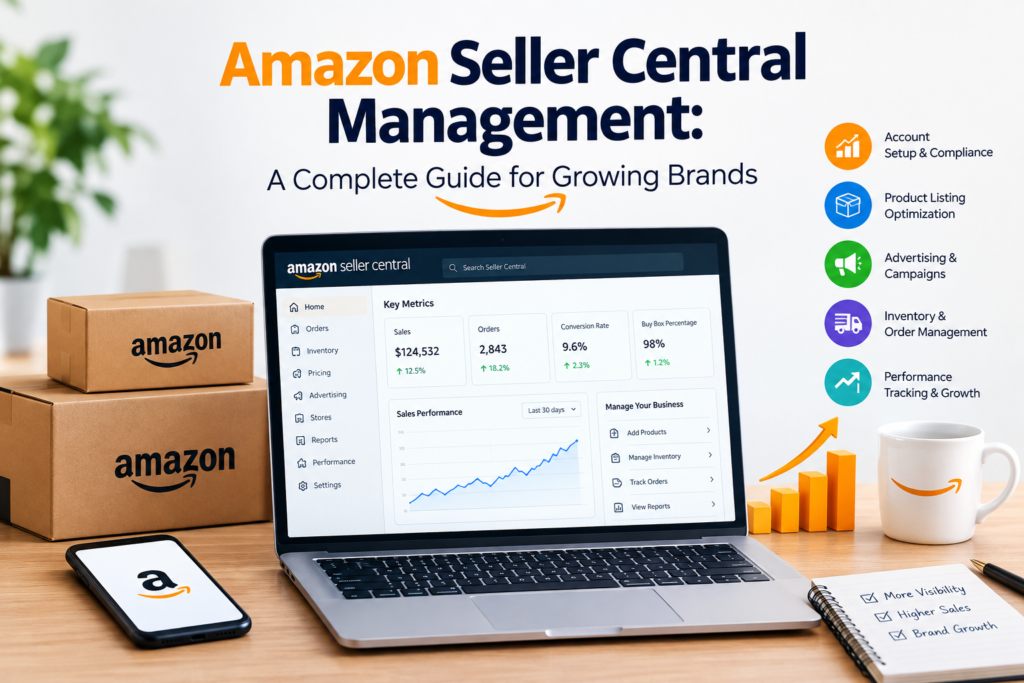
Managing an Amazon business involves much more than adding products and waiting for orders. From product listings and inventory to advertising, pricing, account health, customer experience, and performance reporting, every part of your Seller Central account can influence your sales and profitability.
Amazon Seller Central Management is the ongoing process of managing, monitoring, and optimizing these areas to keep your Amazon business efficient and competitive.
For a new seller, this may involve setting up products, choosing the right fulfillment method, and learning how Seller Central works. For an established brand, it can involve managing multiple SKUs, optimizing Amazon PPC campaigns, monitoring inventory, protecting the brand, analyzing customer behavior, and identifying new growth opportunities.
Amazon describes Seller Central as the central hub where sellers manage products, pricing, orders, inventory, fulfillment, advertising, performance, and other business operations.
This guide explains what Amazon Seller Central Management includes, what you should monitor regularly, which metrics matter, and how professional Amazon Account Management Services can help growing brands.
What Is Amazon Seller Central Management?
Amazon Seller Central is the platform used by third-party sellers to operate their Amazon business. Sellers can use it to list products, manage inventory, process orders, adjust pricing, analyze performance, advertise products, and access Amazon’s seller resources.
However, having access to Seller Central does not mean your account is being properly managed.
Effective Amazon Seller Account Management involves continuously reviewing account data and taking action based on what you find.
For example:
- A product is getting traffic but not converting → optimize the listing.
- A product is selling quickly → forecast inventory and replenish stock.
- PPC sales are increasing but profit is falling → review bids, targeting, and TACoS.
- A listing receives customer complaints → investigate the product and content.
- A competitor changes pricing → evaluate your pricing strategy.
- Account Health shows a warning → address the issue before it becomes more serious.
The objective is not simply to increase sales. It is to build a profitable, sustainable Amazon business.
Why Is Amazon Seller Central Management Important?
Amazon has become highly competitive, and simply having products listed does not guarantee consistent sales.
Effective Amazon Business Management helps sellers maintain control over several important areas simultaneously.
A strong management strategy can help you:
- Improve product visibility
- Increase listing conversions
- Control advertising costs
- Reduce inventory problems
- Monitor account health
- Improve customer experience
- Identify profitable products
- Understand customer behavior
- Discover new growth opportunities
Without regular monitoring, small issues can quickly become expensive problems. A stockout can result in lost sales, an inefficient PPC campaign can waste advertising budget, and a poorly optimized listing can lose potential customers to competitors.
What Does Amazon Seller Central Management Include?
A complete Amazon Store Management strategy typically covers several interconnected areas.
1. Product and Catalog Management
Your catalog is the foundation of your Amazon business.
Effective catalog management includes:
- Creating and updating product listings
- Managing SKUs and ASINs
- Maintaining product titles
- Optimizing bullet points
- Updating product descriptions
- Managing images and videos
- Maintaining variations
- Monitoring listing errors
- Resolving suppressed listings
- Managing product information
A technically correct listing is important, but it also needs to communicate the product’s value clearly.
Your title, images, bullet points, description, keywords, pricing, reviews, and overall customer experience should work together to help shoppers understand why they should choose your product.
2. Amazon Listing Optimization
Getting a product listed is only the first step.
A strong Amazon listing should be designed for both search visibility and conversions.
An effective Amazon Listing Management strategy can include:
- Keyword research
- Relevant title optimization
- Benefit-focused bullet points
- Conversion-oriented descriptions
- High-quality product images
- A+ Content where eligible
- Backend search terms
- Competitor analysis
- Review and customer-feedback analysis
The goal should not be to insert keywords repeatedly. Instead, keywords should be incorporated naturally while making the listing more useful to shoppers.
For brands enrolled in Amazon Brand Registry, additional brand-building tools can become available, including A+ Content, Brand Stores, Brand Analytics, and other brand-focused programs.
3. Inventory and Fulfillment Management
Inventory problems can directly affect Amazon sales.
Too little inventory can result in stockouts and lost sales. Too much inventory can increase storage costs and tie up working capital.
Amazon sellers commonly choose between Fulfillment by Amazon (FBA) and Fulfilled by Merchant (FBM).
FBA
With FBA, sellers send inventory to Amazon fulfillment centers, while Amazon handles fulfillment-related operations for eligible products.
FBM
With FBM, the seller manages fulfillment and ships orders directly or through a third-party logistics provider.
The right option depends on factors such as:
- Product size
- Sales velocity
- Margins
- Storage requirements
- Operational capabilities
- Customer expectations
- Fulfillment costs
Professional Amazon Inventory Management should monitor inventory at the SKU level, rather than simply looking at total stock.
Important areas to monitor include:
- Current inventory
- Sales velocity
- Replenishment requirements
- Stockout risk
- Slow-moving inventory
- Excess inventory
- FBA inventory
- Stranded inventory
4. Amazon PPC and Advertising Management
Advertising is an important part of growing visibility on Amazon.
A structured Amazon PPC Management strategy can include:
Sponsored Products
Useful for promoting individual products and targeting relevant shopping searches.
Sponsored Brands
Available to eligible brands and useful for increasing brand visibility and promoting multiple products.
Sponsored Display
Can help reach relevant audiences beyond traditional keyword-based placements.
But simply running campaigns isn’t enough.
Effective Amazon Advertising Management requires continuous optimization of:
- Keywords
- Search terms
- Bids
- Budgets
- Targeting
- Negative keywords
- Campaign structure
- Product targeting
- Placement performance
One of the most important distinctions is between ACoS and TACoS.
ACoS = Ad Spend ÷ Ad Revenue × 100
While ACoS helps measure advertising efficiency, TACoS compares advertising spend with total sales and can provide a broader view of how advertising relates to the overall business.
A campaign with strong sales can still be problematic if advertising costs are consuming too much of the product’s profit.
5. Account Health and Compliance
Account Health should never be treated as something to check only when Amazon sends a warning.
Sellers should regularly monitor account notifications, policy issues, listing restrictions, customer experience concerns, and other performance indicators.
Compliance can involve areas such as:
- Product documentation
- Category requirements
- Intellectual property
- Product safety
- Listing policies
- Customer service
- Shipping performance
- Review policies
- Pricing policies
The best approach is preventive account management.
Instead of waiting for an account problem to become serious, professional Amazon Account Management Services can help identify potential issues early and work toward resolving them.
6. Brand Registry and Brand Management
For established brands, Amazon management should go beyond individual product listings.
Amazon Brand Registry is designed to help eligible brands protect and grow their presence on Amazon.
Depending on eligibility, brands can use tools such as:
- A+ Content
- Brand Stores
- Sponsored Brands
- Brand Analytics
- Amazon Attribution
- Brand protection tools
- Brand Metrics
For growing brands, Amazon Brand Management should focus not only on selling individual products but also on building a recognizable and consistent brand presence.
7. Amazon Brand Analytics and Business Intelligence
One of the biggest mistakes sellers make is looking only at revenue.
Sales numbers tell you what happened. Analytics can help you understand why it happened.
For eligible brands, Amazon Brand Analytics can provide insights into areas such as customer journeys, search performance, repeat purchases, demographics, and market basket behavior.
This information can help brands answer questions such as:
- Which search terms are bringing customers?
- Which products generate repeat purchases?
- Which products are commonly purchased together?
- Which products need better conversion?
- What customer segments are buying?
- Where are new opportunities emerging?
The objective is to turn Seller Central data into business decisions.
Amazon Seller Central Management: Daily, Weekly and Monthly Checklist
A practical management system should have different levels of monitoring.
Daily Amazon Management Checklist
- Check orders and fulfillment
- Review account notifications
- Monitor inventory alerts
- Check major PPC campaigns
- Monitor product pricing
- Check listing issues
- Review important customer feedback
- Identify urgent account problems
Weekly Amazon Management Checklist
- Analyze PPC search terms
- Optimize bids and budgets
- Review inventory levels
- Check listing performance
- Analyze conversion rates
- Review customer feedback
- Check Account Health
- Monitor competitors
- Identify underperforming products
- Review stranded or unavailable inventory
Monthly Amazon Management Checklist
- Analyze total revenue
- Review profitability
- Compare ACoS and TACoS
- Analyze SKU-level performance
- Review inventory turnover
- Evaluate advertising contribution
- Identify new keyword opportunities
- Review brand performance
- Create a growth plan for the next month
This structured approach prevents Amazon management from becoming a reactive process.
Key Amazon Seller Central Metrics to Monitor
A professional Amazon Seller Central Management strategy should track more than sales.
| Business Area | Important Metrics |
| Sales | Revenue, Units Sold |
| Traffic | Impressions, Sessions, Page Views |
| Conversion | Unit Session Percentage |
| Advertising | ACoS, TACoS, ROAS |
| Inventory | Stock Levels, Sell-Through |
| Customer | Returns, Feedback, Customer Experience |
| Product | SKU Revenue, Conversion Rate |
| Account | Account Health |
| Brand | Search and Customer Insights |
The exact metrics that matter most will depend on your product category, business model, margins, and growth stage.
How Amazon Seller Central Management Improves Business Growth
Effective management creates a continuous optimization cycle:
Analyze → Identify → Optimize → Measure → Scale
For example, suppose a product receives plenty of traffic but has a low conversion rate.
Instead of immediately increasing advertising spend, you could investigate:
- Product images
- Pricing
- Reviews
- Product benefits
- Listing content
- Competitor offers
- Customer objections
After improving the listing, you can measure conversion again.
Similarly, if PPC generates sales but TACoS continues to rise, the answer may not simply be to increase the budget. You may need to improve organic visibility, reduce inefficient targeting, improve conversion, or restructure campaigns.
This is why Amazon Account Management is a business function, not just an administrative task.
When Should You Hire Professional Amazon Account Management Services?
Managing Seller Central yourself can work when you have a small catalog and enough time to monitor the account.
Professional Amazon Account Management Services become more valuable when:
- You have multiple SKUs.
- Your advertising spend is increasing.
- Your listings are not converting consistently.
- Inventory problems are affecting sales.
- Account Health issues require regular attention.
- You are launching new products.
- You want to scale your Amazon revenue.
- You don’t have an experienced Amazon specialist internally.
- You want better reporting and profitability analysis.
- You are expanding across Amazon marketplaces.
A professional team can combine catalog management, listing optimization, Amazon PPC Management, inventory monitoring, account health, analytics, and growth strategy into one coordinated process.
Amazon Seller Central Management vs. Simply Selling on Amazon
There is a major difference between being present on Amazon and actively managing an Amazon business.
Simply selling means:
List products → Receive orders → Ship products.
Professional management looks more like:
Research → Optimize → Advertise → Analyze → Improve → Protect → Scale.
The second approach is more suitable for brands that want to build Amazon into a predictable and profitable sales channel.
Final Thoughts
Amazon Seller Central is much more than a dashboard for checking orders. It is the operational center of an Amazon business, covering products, inventory, fulfillment, pricing, advertising, customer experience, analytics, and account performance.
The real challenge is not knowing where each feature is located. It is knowing what to monitor, what to change, and when to take action.
For growing brands, effective Amazon Seller Central Management should focus on three things:
Operational efficiency + profitable growth + long-term account health.
Whether you manage your account internally or work with an experienced Amazon management team, the goal should remain the same: create better listings, control costs, maintain healthy inventory, improve advertising efficiency, understand customer behavior, and build a stronger Amazon presence.
At EcomExpert, our approach to Amazon Account Management Services focuses on Amazon as a complete growth channel rather than a collection of individual tasks. By combining Amazon Listing Management, PPC optimization, inventory monitoring, account health, catalog management, and performance analysis, brands can make better decisions and build a stronger foundation for sustainable Amazon growth.