
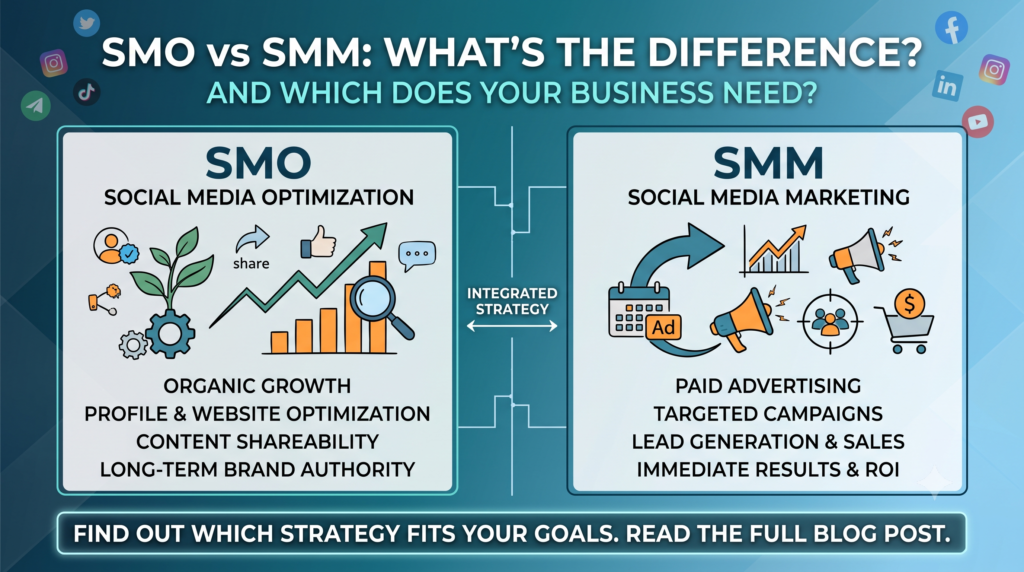
SMO and SMM get used as if they’re the same thing, and most business owners never get a straight answer on how they differ — because a lot of agencies quote one and quietly deliver the other. They’re related but genuinely different disciplines, aimed at different goals. Here’s the actual difference, and how to tell which one solves your problem.
Is Guide Mein
The One-Line Difference
SMO (Social Media Optimization) is about presence and discoverability — making your profiles complete, consistent, and easy to find, and optimising organic content so it performs without paid boosting. SMM (Social Media Marketing) is about paid promotion and campaign management — running ads, targeting audiences, and buying reach rather than earning it organically.
Think of SMO as the foundation and SMM as what you build on top of it once that foundation exists.
What SMO Actually Involves
- Profile optimization across platforms — consistent branding, complete bio information, correct contact details, and links back to your website
- Organic content strategy — posting content designed to get shared, saved, and engaged with, without spending on boosting
- Hashtag and keyword research for the platforms that support discovery (Instagram, Pinterest, YouTube in particular)
- Cross-platform consistency — the same brand voice and visual identity whether someone finds you on Instagram, LinkedIn, or YouTube
- Community management — replying to comments and DMs, which social platforms increasingly factor into how much organic reach they give a page
The goal of SMO is reach without a media budget — getting found through search-like behaviour on social platforms and through content people choose to engage with and share.
What SMM Actually Involves
- Paid ad campaigns on Meta, Instagram, LinkedIn or other platforms, targeted by audience, interest, or behaviour
- Campaign structure and budget management — testing creative, adjusting targeting, and optimising spend toward conversions
- Retargeting — showing ads to people who’ve already visited your site or engaged with your content
- Performance tracking — cost per click, cost per lead, return on ad spend, tied to actual business outcomes
The goal of SMM is reach on demand — you pay, and the platform delivers an audience matching your targeting, immediately, regardless of how good your organic content is that week.
A Side-by-Side Comparison
| SMO | SMM | |
|---|---|---|
| Cost model | Time and content investment, no media spend | Content plus paid ad budget |
| Speed of results | Slower, compounds over months | Immediate, stops when spend stops |
| Best for | Brand presence, discoverability, trust signals | Lead generation, launches, time-sensitive promotions |
| Typical output | Optimised profiles, organic posts, engagement | Ad campaigns, targeted reach, conversion tracking |
Which One Your Business Actually Needs
If your social profiles are inconsistent, incomplete, or barely posted to — start with SMO. Running paid ads to a profile with no bio, inconsistent branding, and three-month-old posts wastes ad spend on an audience that clicks through and immediately loses trust.
If you need leads or sales in the next 30 days — SMO alone won’t move fast enough. You need SMM, ideally pointed at a profile and landing experience that SMO has already made credible.
Most businesses need both, in sequence, not as a single bundled thing. Get the organic foundation credible first — even a few weeks of consistent, optimised presence — then layer paid campaigns on top of it. Paid traffic landing on a weak, inconsistent profile converts worse than the same spend landing on one that already looks trustworthy.
Common Confusion in Agency Pitches
A lot of “social media marketing” packages in India are actually just content posting — SMO dressed up as SMM, with no actual ad spend or campaign management involved. That’s not wrong to buy, but it’s important to know what you’re paying for. Ask directly: is there a media budget involved, or is this organic content and profile management? The answer tells you which discipline you’re actually getting.
The Honest Summary
SMO builds the presence that makes paid spend worth spending. SMM buys reach on demand once that presence exists. Skipping SMO and going straight to ads means paying to send traffic somewhere unconvincing; skipping SMM when you need fast results means waiting on organic growth that takes months to compound. Most businesses need the sequence, not a choice between them.
Not sure which one your business needs right now? WhatsApp your social profiles to +91 92113 84333 and we’ll tell you honestly whether you need organic groundwork first, paid campaigns now, or both together.
Related: How Much Does SEO Cost in India? · Facebook & Instagram Ads for Local Businesses
Not Sure Which One You Need?
WhatsApp your social profiles to +91 92113 84333 and we will tell you honestly whether you need organic groundwork, paid campaigns, or both.