
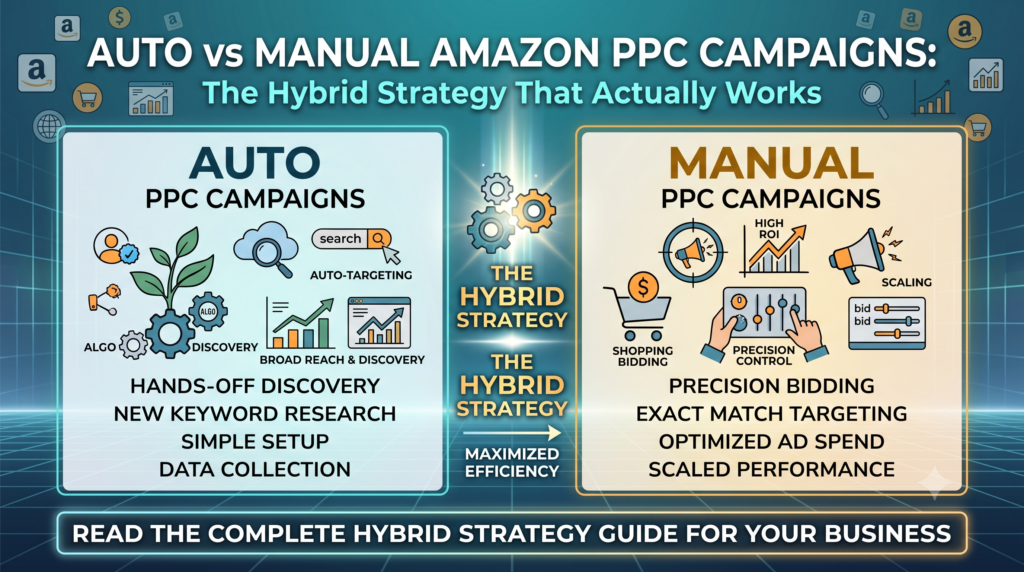
Sellers usually ask us “should I run auto or manual campaigns,” as if it’s a fork in the road. It isn’t. Run only auto and you never gain control over your best keywords. Run only manual and you stop discovering the searches you didn’t think to target. The accounts that perform best run both, feeding each other in a loop. Here’s how that loop actually works.
Is Guide Mein
What Auto Campaigns Are Good At
Auto campaigns let Amazon match your ad to relevant searches using its own algorithm, across four targeting types — close match, loose match, substitutes, and complements. You don’t pick the keywords; Amazon does, based on your listing content.
This makes auto genuinely good at one job: discovery. It surfaces real customer search terms you would never have thought to bid on manually — misspellings, use-case phrasing, category terms adjacent to yours. On a brand-new listing with no keyword history, auto is often the fastest way to learn what people actually type when they’re about to buy your kind of product.
What it’s bad at: control. You can’t set different bids per keyword, and irrelevant matches (especially under “loose match” and “substitutes”) creep in and burn spend on searches that were never going to convert. Left alone indefinitely, an auto campaign gets less efficient, not more.
What Manual Campaigns Give You That Auto Can’t
Manual campaigns let you choose the exact keywords or products to target and set a bid on each one individually. That precision is the entire point.
Exact match manual campaigns should hold your proven converters — the keywords you already know work, protected with dedicated budget so they never lose out to weaker terms competing for the same pool of spend. Phrase and broad match manual campaigns sit in between — narrower than auto, wider than exact, useful for controlled expansion around a keyword you know converts.
Manual campaigns don’t discover anything on their own. They only perform as well as the keyword list you feed them, which is exactly where auto comes in.
The Hybrid Loop
This is the structure we run on every client account:
- Auto campaign runs continuously, small budget, pure discovery — its job is never to be the primary revenue driver.
- Weekly, pull the search term report from the auto campaign (and from any broad/phrase manual campaigns) and look for terms with real conversions.
- Harvest the winners. Any search term converting well gets added as an exact-match keyword in a dedicated manual campaign, with a bid you control directly.
- Negative the same term in the auto campaign once it’s been harvested, so you aren’t paying twice — once in auto at an uncontrolled bid, once in manual at a controlled one — for the same search. See our negative keywords guide for the exact process.
- Repeat weekly. The auto campaign keeps discovering; the manual exact campaign keeps absorbing the winners and growing in precision.
Over a few months, this loop turns a single unstructured auto campaign into a tight exact-match campaign carrying most of your sales, with auto still running quietly underneath to catch whatever comes next.
Campaign Structure at a Glance
| Campaign Type | Purpose | Budget Share (typical) | Bid Control |
|---|---|---|---|
| Auto | Discovery, ongoing research | 10-20% | None (Amazon decides) |
| Exact match manual | Proven converters, protected | 50-65% | Full, per keyword |
| Phrase/broad manual | Controlled expansion | 20-30% | Full, per keyword |
These ratios shift with account maturity — a brand-new launch leans harder on auto because there’s nothing proven yet to put in exact match; a mature account leans harder on exact because most of the useful keywords have already been harvested.
How Often to Harvest
Weekly is the right cadence for most accounts. Daily is too noisy — you won’t have enough clicks yet to tell a real winner from randomness. Monthly is too slow — you’re leaving proven keywords sitting in an unprotected auto campaign for weeks, exposed to Amazon’s own bidding logic instead of yours.
The exception is a brand-new launch in its first two weeks: check search terms every 3-4 days early on, since the volume of new data is highest right after launch and the cost of missing an early winner is highest too.
Common Mistakes
- Turning auto off once manual is set up. This kills discovery entirely — you stop learning what new searches are converging on your listing, especially as seasons or competitor activity shift buyer language.
- Harvesting into broad match instead of exact. This defeats the purpose — you want the protected, controlled bid that only exact match gives you for a term you already know works.
- Never negating harvested terms in the source campaign. You end up bidding against yourself for the same search, in two campaigns, at two different (often conflicting) bids.
- Judging auto campaigns on ACoS alone. Auto’s job is discovery, not efficiency — a slightly higher ACoS on auto is the cost of finding the next keyword that manual will later carry efficiently. Judge auto on what it surfaces, not what it costs.
Why This Beats Either Extreme
Auto-only accounts plateau — you get whatever Amazon’s matching logic decides to show you, with no way to double down on what’s actually working. Manual-only accounts stagnate — you keep bidding the same known list while the market’s search language quietly shifts around you. The hybrid loop is slower to set up than either extreme, but it’s the only one of the three that keeps improving on its own.
Want this loop running on your account without doing the weekly report-pulling yourself? WhatsApp +91 92113 84333 — our Amazon PPC management runs the harvest-and-negative cycle every week and reports what moved and why.
Related: Amazon Negative Keywords: The Complete Guide · Sponsored Products vs Sponsored Brands vs Sponsored Display
Want This Loop Running on Autopilot?
WhatsApp +91 92113 84333 — we run the harvest-and-negative cycle every week and report what moved and why.