
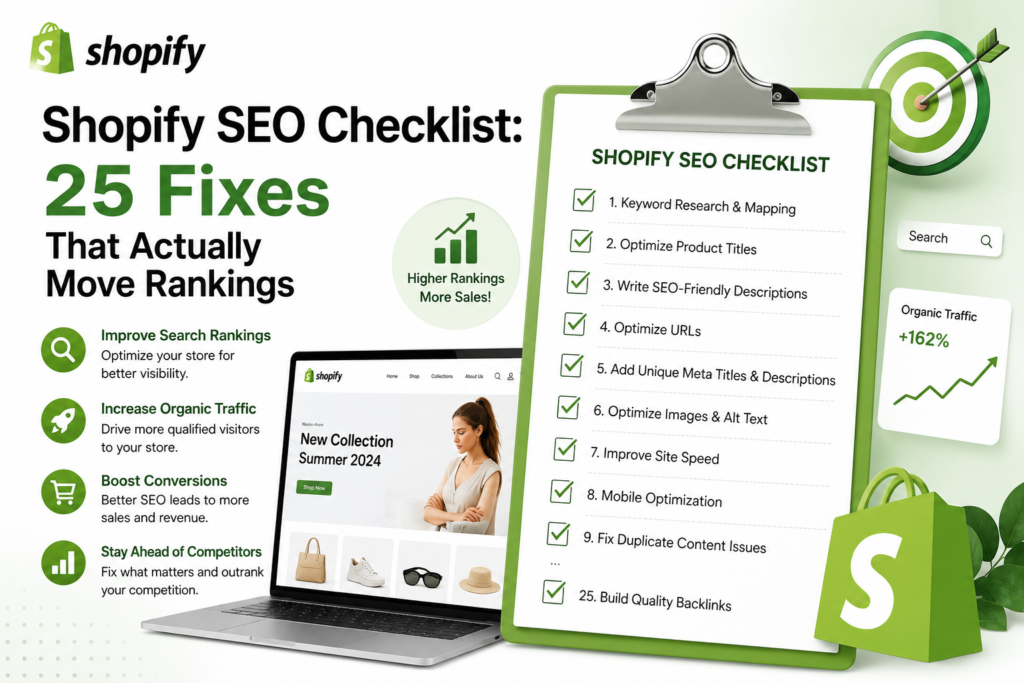
Most Shopify SEO checklists are 80 items long and treat “add a favicon” as equal to “fix duplicate collection URLs”. This one is ordered by impact, and tells you what to skip. Work top to bottom. (Part of our complete Shopify SEO guide.)
Checklist Sections
Technical Foundation (do these first)
- Verify Google Search Console and submit your sitemap. Shopify generates
/sitemap.xmlautomatically. Without GSC you are optimizing blind. - Check indexation. Search
site:yourstore.com. If Google has indexed far more URLs than you have products and collections, you have duplication to fix. - Audit duplicate product URLs. Confirm
/collections/x/products/ycanonicalises to/products/y. Themes and apps break this more often than you would expect. - Block crawl waste in robots.txt.liquid. Internal search results, filtered variants and tag pages consume crawl budget and rank for nothing.
- Fix redirect chains. Every handle change creates a redirect; chained redirects leak equity. Consolidate them.
- Remove or noindex thin pages. Empty collections, placeholder pages and duplicate policy pages dilute site quality.
- Check mobile rendering. Most Indian traffic is mobile. Test on an actual phone, not just a desktop resize.
Speed & Core Web Vitals
- Audit installed apps. Uninstall anything unused — leftover scripts persist even when the app is inactive. This is the biggest speed lever on Shopify.
- Compress and resize images. Serve modern formats at the dimensions actually displayed, not 3000px originals scaled down in the browser.
- Lazy-load below-the-fold images so the first paint is not waiting on the whole page.
- Defer non-critical scripts. Chat widgets, review apps and analytics rarely need to block rendering.
- Measure with PageSpeed Insights on three page types: homepage, a collection and a product. They fail differently.
If speed is your main problem, it is worth treating as its own project — see our speed optimization service.
Collection Pages (the biggest untapped win)
- Write 150–300 words of real copy on every priority collection, placed so it does not push products below the fold.
- Keyword-led H1s that read naturally — “Cotton Kurtis for Women”, not “Collection”.
- Unique meta titles and descriptions per collection. Templated ones with the store name repeated help nobody.
- Link between related collections so equity flows and buyers keep browsing.
Most Indian Shopify stores have never written collection copy. Doing this alone puts you ahead on the queries with buying intent.
Product Pages
- Rewrite supplier descriptions. Copied text on a hundred stores gives Google no reason to pick yours.
- Buyer-language titles including the attributes people search: material, size, use case.
- Alt text on every image, describing the product rather than stuffing keywords.
- Product schema so price, availability and ratings show in search results.
- Answer buying questions on the page — fit, care, delivery, returns. Fewer doubts, better conversion, longer dwell time.
Content & Authority
- Build one pillar-and-cluster set around your main category rather than scattering unrelated posts.
- Link blog content into collections — content that never links to a money page earns nothing.
- Earn genuine links through guest posts, digital PR and useful free resources. Never buy them.
- Publish consistently. Two solid posts a month for a year beats twenty in one month and then silence.
What to Skip
- Keyword density targets. Not a ranking factor. Write for the buyer.
- Meta keywords tag. Google has ignored it since 2009.
- Submitting to 500 directories. Modern link spam, and it can hurt you.
- Chasing exact-match domains or doorway pages for every city. Google treats them as what they are.
- Obsessing over one SEO plugin score. A green light in an app is not a ranking.
How to Use This List
Work in order. Technical first, because content on a broken foundation is wasted. Then collections, because they carry commercial intent. Then products. Content and links last, because they compound only once everything under them works.
Want it done for you? Our Shopify SEO service starts with a free audit — send your store link on WhatsApp to +91 92113 84333 and we will send the three biggest gaps we find, free.
Next in this series: Shopify Product Page SEO. Back to the pillar guide.
Want This Done For You?
Send your store link on WhatsApp at +91 92113 84333 and we will send back the three biggest gaps from this checklist that your store is failing — free.